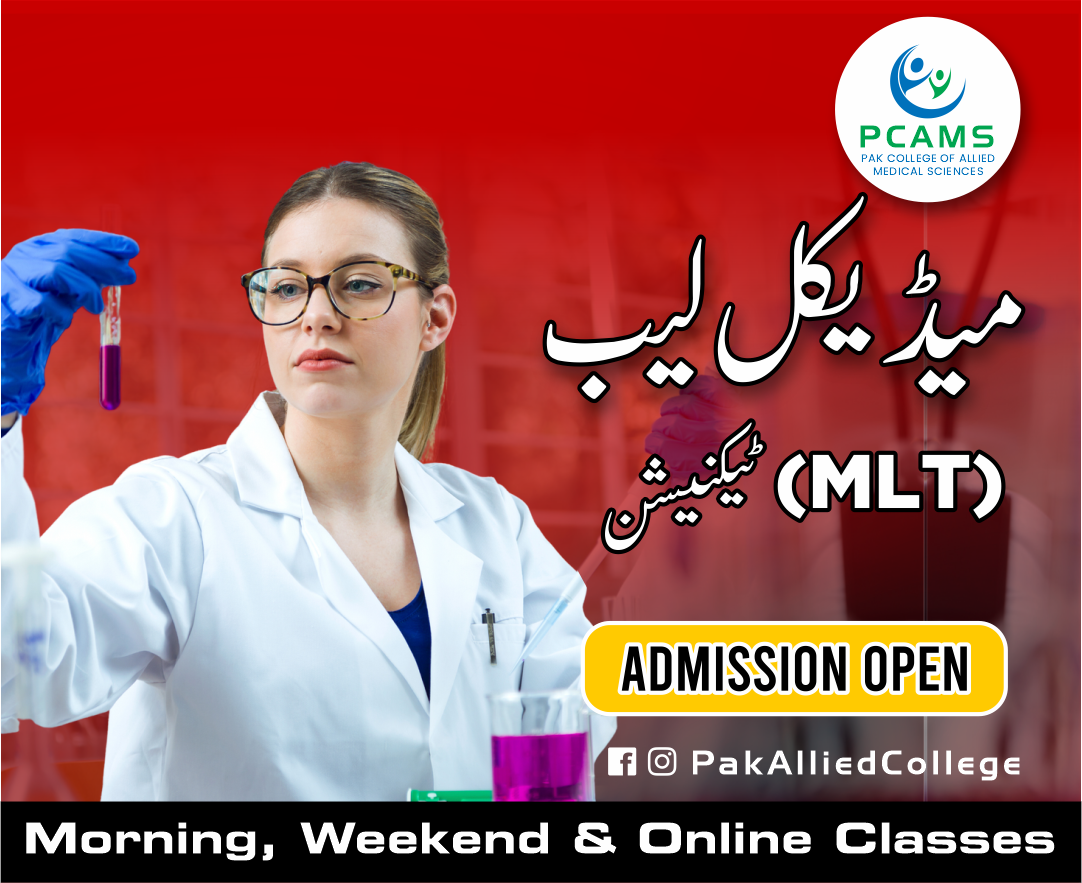
Pak College of Allied Medical Sciences (PCAMS) is a registered institute and holds affiliation with the Punjab Medical Faculty. We proudly offer a comprehensive 2-year course, recognized as an equivalent qualification to FSC. With a single fee payment, enrolled students will have the opportunity to earn a MLT (Medical Lab Technician) that is also recognized as a FSC degree.
Affiliation
The Punjab Medical Faculty has granted affiliation to Pak College of Allied Medical Sciences (PCAMS) for the purpose of conducting its educational program.
Benefits of a MLT (Medical Lab Technician)
A Medical Lab Technician (MLT) diploma offers numerous benefits to individuals interested in pursuing a career in the medical laboratory field. Here are some of the key advantages:
Vital Role in Healthcare: MLTs play a critical role in healthcare by performing laboratory tests that aid in the diagnosis, treatment, and prevention of diseases. Their work directly contributes to patient care and helps doctors make informed medical decisions.
Shorter Duration: A diploma program for Medical Lab Technicians generally has a shorter duration compared to a full degree program. This allows individuals to enter the workforce more quickly and start gaining hands-on experience.
In-Demand Profession: The demand for skilled Medical Lab Technicians continues to grow as the need for accurate medical testing and diagnostic services increases. Graduates with MLT diplomas are well-positioned to secure employment in various healthcare settings.
Practical Training: MLT diploma programs emphasize practical skills and hands-on training in laboratory techniques, instrumentation, and sample analysis. This hands-on experience prepares students to perform a wide range of tests accurately and efficiently.
Diagnostic Skills: MLTs learn to operate and maintain laboratory equipment, analyze samples, and interpret test results. Their ability to identify abnormal results and potential issues is crucial for aiding physicians in diagnosing illnesses and determining appropriate treatment plans.
Variety of Work Settings: MLTs can work in various healthcare settings, including hospitals, clinics, private laboratories, research facilities, public health departments, and blood donation centers. This versatility provides opportunities for individuals to choose a work environment that aligns with their interests.
Career Advancement: While an MLT diploma serves as an entry point, it can also pave the way for career advancement. Some MLTs choose to pursue further education or certifications to specialize in areas such as molecular biology, hematology, immunology, or microbiology.
Laboratory Safety and Quality: MLT programs emphasize the importance of laboratory safety, quality control, and adherence to regulations and protocols. Graduates are well-versed in maintaining a sterile and safe laboratory environment.
Critical Thinking and Problem Solving: MLTs encounter a variety of challenges in the laboratory, such as troubleshooting instrument issues or resolving discrepancies in test results. This enhances their critical thinking and problem-solving skills.
Interdisciplinary Collaboration: MLTs work closely with other healthcare professionals, including doctors, nurses, and pathologists, to ensure accurate and timely test results. Effective communication and collaboration are essential components of their role.
Personal Fulfillment: Contributing to patient care and medical diagnoses can be deeply rewarding. MLTs have the satisfaction of knowing that their work directly impacts patient outcomes and helps improve overall healthcare.
Stable Job Market: The healthcare field, including medical laboratory technology, offers job stability due to its essential role in healthcare delivery. MLTs are in demand, making it a reliable career choice.
Continuing Education: MLT diploma graduates can continue their education to pursue higher degrees, such as a Bachelor’s in Medical Laboratory Science, which can lead to expanded career opportunities and higher earning potential.
Eligibility Criteria
Matric with science subjects
Minimum 45 % Marks
No age limit